
Polarization observation simulations through the Roman Space Coronagraph Instrument
The polarimetric mode is one of the "best-effort" observing mode for the Nancy Grace Roman Space Telescope Coronagraph Instrument and can perform polarimetric observations of debris disks and exoplanets around nearby stars in addition to their high-contrast and high-resolution imaging. The polarimetric module consists of two Wollaston prisms, each producing two orthogonally polarized images (I0, I90 and I45, I135) that are separated by 7.5". Polarimetric imaging is available for the narrow field with the Hybrid Lyot Coronagraph (HLC) at 575 nm and the wide field with the Shared Pupil Coronagraph (SPC) at 825 nm. The accuracy requirement in a linear polarization fraction (LPF) measurement per spatial resolution element (2×2 pixels in HLC and 3×3 pixels in SPC) is < 3%. However, Monte Carlo simulations using uncertainty in calibration, flat fielding, and photometric noise on standards estimate an RMS error in LPF measurement per resolution element to be 1.66% (Mennesson et al. 2021, SPIE, 11823E, 10; Zellem et al. 2022, SPIE, 12180E, 1). Polarization observations through the Roman Coronagraph will play a vital role in providing constraints on some of the disks already observed by GPI and SPHERE with its complementary observations in optical wavelength regimes in addition to resolving the fainter dust rings much closer (around 1 AU) to nearby stars.
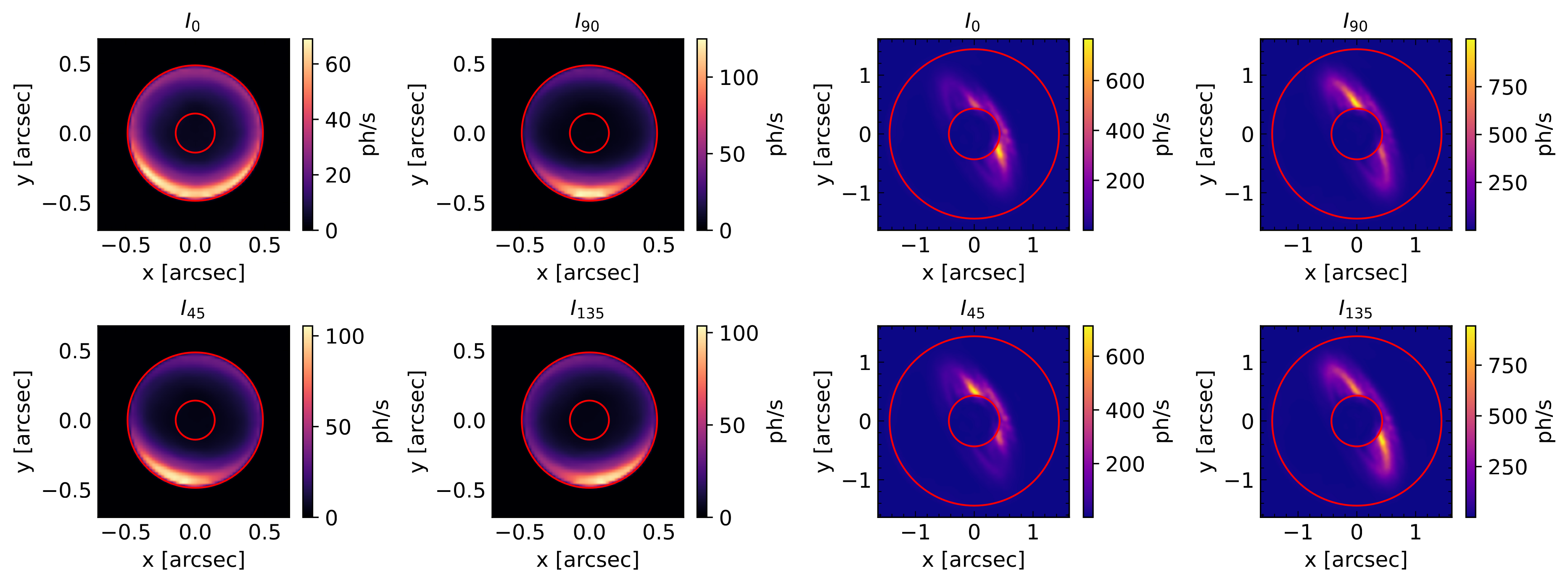
In the current suite of simulations, we have generated simulated polarimetric observations of two very well known debris disk system: A nearby (early) Sun-like star, Epsilon Eridani (ε Eri), and an A0V star harboring an extensively studied debris disk, HR 4796A. The disk models are generated using the radiative transfer modeling software MCFOST (Pinte et al. 2006, A&A, 459, 797; 2009, A&A, 498, 967) to obtain the total intensity image and Stokes parameters Q and U images for linear polarization. We converted the Stokes Q and U images obtained from MCFOST to Qφ and Uφ, such that the electric field vector direction (in the polarization) is radially oriented with respect to the central star. The orthogonal polarization components of the disks are convolved with the Roman Coronagraph Instrument point response functions (PRFs) obtained using the PROPER (Krist 2007, SPIE, 6675E, 0P) models run for the HLC and SPC modes. The convolved images are used to generate the EMCCD raw images, including the EMCCD gain and noise characteristics using emccd-detect. The speckle and jitter noise are added using Observing Scenario 9 ("OS9") simulations of the HLC mode and OS 11 ("OS11") simulations for the SPC mode. The final step is the estimation of Stokes parameters, polarization intensity, and total intensity after incorporating the instrumental polarization and polarization crosstalk from the pupil-averaged Mueller matrices of the instrument. These simulations validate that the Roman Coronagraph Instrument design meets the science requirement developed early in the design process (NB: no longer a requirement) to: "map the linear polarization of a circumstellar debris disk that has a polarization fraction greater than or equal to 0.3 with an uncertainty of less than 0.03."
Disk models
For ε Eri, the disk models include an inner warm disk with two narrow belts (1.5–2 AU and 8–20 AU), using dust properties from Su et al. (2017, AJ, 153, 226). The IR excess estimated from the MCFOST modeled spectral energy distribution (SED) is compared with the observed Spitzer-IRS spectrum obtained from Su et al. (2017) and broadband photometry from Backman et al. (2009, ASPC, 324, 9). The grain composition for the inner-most ring could be either 100% astrosilicates or 100% olivine, or astrosilicates (50%) + olivine (50%), and all three models estimate similar IR excess, SPF. The disk in our simulations is modeled with an inclination of 34° and a position angle (PA) of 266° (Booth et al. 2017, MNRAS, 469, 3200) for the narrow-band filter with a bandpass FWHM of 56.5 nm and a central wavelength of 575 nm. The scattered-light and Stokes-parameter images are 256 × 256 pixels in size, with a pixel scale of 21.84 mas pixel-1. We estimated a maximum polarized intensity of 0.32 mJy arcsec-2 and the corresponding polarization fraction of 0.37±0.01 in one resolution element (3×3 pixels) in the direction of forward scattering of the disk. We also scaled the polarized intensity and total intensity to a surface brightness of 0.168 mJy arcsec-2 per pixel derived from the expected contrast level of 2×10⁻⁸ from the non-detection of inner disk of ε Eri in HST observations from Douglas et al. (2024, SPIE, 10705E, 26).
For HR 4796A, the disk models include one of the best-fit models as an example disk from Milli et al. (2017, A&A, 599 A108; 2019, A&A, 626, A54). The disk is modeled with an inclination of 75.8° and a PA of 27.7° for the broadband filter with a bandpass FWHM of 96.8 nm and a central wavelength of 825.5 nm. The array dimensions and pixel scale of the Stokes images are the same as those for ε Eri. We estimate a peak polarization fraction of 0.92±0.01 and a polarized intensity of 35.25±0.01 mJy arcsec-2.
The disk models are provided for the two debris disks for the HLC and SPC in separate .fits files:
- Total intensity, Q and U images
- Orthogonal polarization components (I_0, I_90, I_45 and I_135)
- Convolved orthogonal polarization components ("convolved disk" I_0, I90, I_45 and I_135)
The files are contained in a zip file which can be obtained here. Note that the HLC files correspond to ε Eri, and the SPC files correspond to HR 4796A.
These models can be run through the Jupyter notebooks available here, https://github.com/ramya-anche/polarization-simulations-romanCGI, to obtain output polarization fraction after incorporating all of the noise properties.
Please see Anche et al. (2023, PASP, 135, 1054, 125001; 2024, SPIE, 13092E, 57) for more information.