Cycle 1 Approved Programs

Roman Science Support Center Announces Cycle 1 General Investigator Program Selections

Following the review of the 374 proposals submitted for the inaugural Cycle 1 Call, the Roman Science Support Center is pleased to announce the selection of 118 programs for the Roman Cycle 1 General Investigator Program. This marks a historic milestone for the Nancy Grace Roman Space Telescope, establishing the core of the community-driven science program for its first year of operations.

A key component of Roman’s scientific strategy is empowering the community to deeply explore its expansive datasets. Reflecting this focus, the vast majority of the approved selections are dedicated to data analysis, theoretical investigations, and laboratory astrophysics. To maximize the mission's early science return across investigations of varying scales, the approved programs are distributed across the following sizes:

  • Small: 61 programs
  • Medium: 45 programs
  • Large: 12 programs

Of these 118 selected investigations, five are programs requesting General Astrophysics Surveys, which will utilize a total of 1,456 hours of telescope time. The Cycle 1 proposals oversubscribed the funding allocation by a factor of 4.5 and the available hours by a factor of 10.

The approved programs span Roman’s broad scientific capabilities, covering a diverse array of astronomical topics broadly from the solar system to large scale structure of the universe. The list of programs are in the tables below.
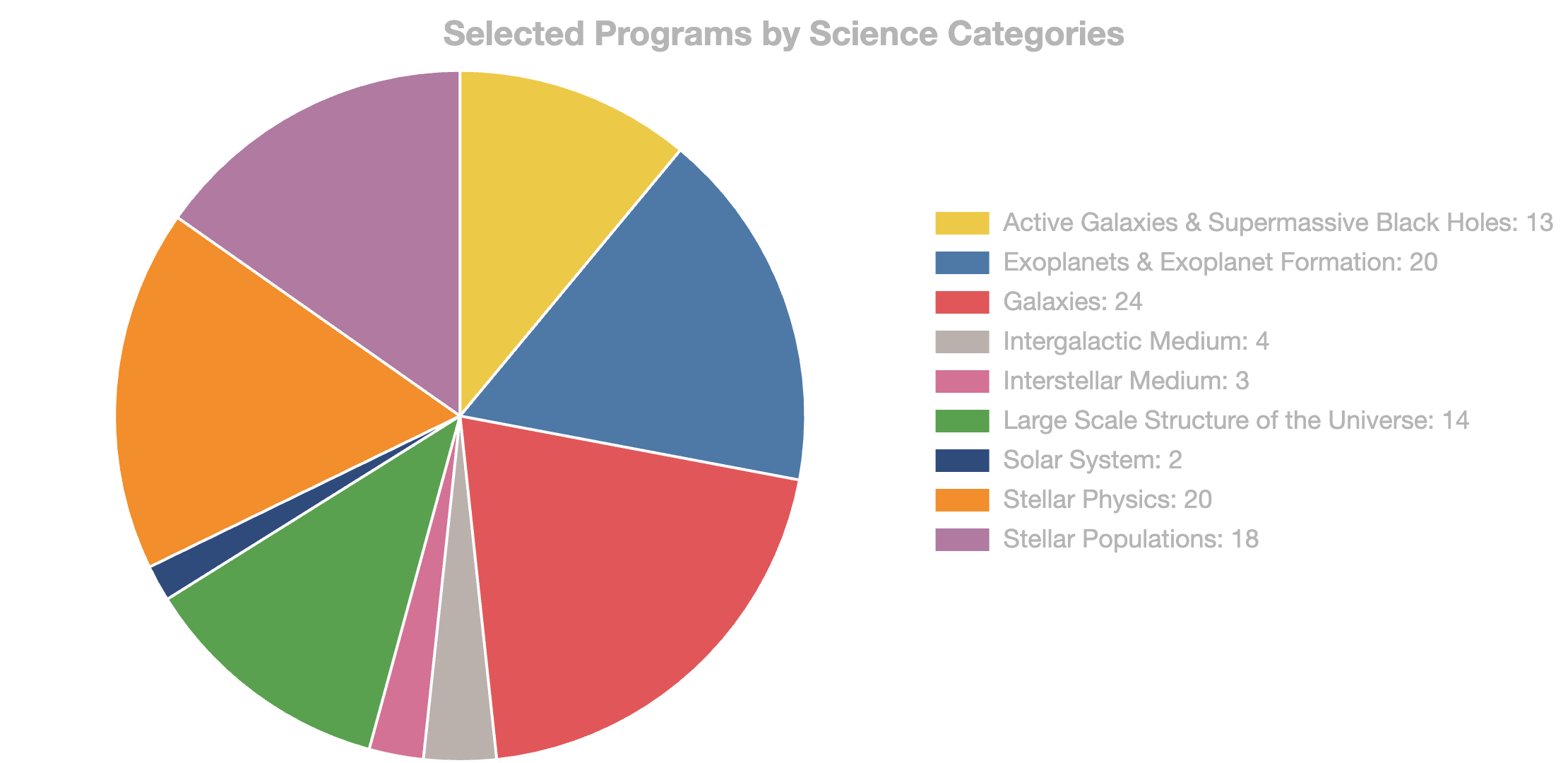
Cycle 1 Program Statistics

We extend our deep gratitude to the peer reviewers and Telescope Allocation Committee members who dedicated their time and expertise to this critical evaluation process.

To view the details of a specific program, click on the Program ID number in the tables below.

Active Galaxies & Supermassive Black Holes
ID Program Title PI and Co-PIs Program Type
19007 Roman and the Rise of Giants: Black-Hole Growth in Forming Galaxy Clusters Wei Leong Tee Analysis
19009 A Complete Census for Gravitationally Lensed Quasars with Roman Minghao Yue, Jiani Ding Analysis
19033 Bridging the Missing Link: Little Red Dots at z~0.5–2 with Roman HLWAS Yichen Liu, Xiaohui Fan, Xiaojing Lin Analysis
19037 Probing AGN structure using microlensing from z = 0.5 to z = 4.5 Padmavathi Venkatraman, Yue Shen Analysis
19039 Off-nuclear tidal disruption events observed by Roman Space Telescope Kishore Patra Analysis
19042 Revealing Supermassive Black Hole Growth Through the Synergy of Roman and LSST Jinyi Yang Analysis
19062 Where Do Little Red Dots Go After Cosmic Dawn? A Wide-Area Roman Census at Cosmic Noon Vasily Kokorev Analysis
19067 A Census of Black Hole Evolution using High-Ionization Emission Lines Nikko Cleri Analysis
19075 Understanding the Black Hole-Galaxy Coevolution of Roman’s Extreme Galaxies by Bridging Galaxy and Event-Horizon Scales Kung-Yi Su, Claude-Andr´e Faucher-Gigu`ere Analysis
19090 High-Redshift AGN Reverberation Mapping and Variability with Roman Zachary Stone Analysis
19095 Red Dots at Cosmic Noon with Roman Ryan Hickox Analysis
19108 Beyond the Bright Tail: Faint Reionization-Era Quasars with Archival Roman Grism Data Mainak Singha Analysis
19112 Tidal Disruption Events in the Gas-Rich Early Universe: A New Window into Black Hole Growth with Roman Fulya Kiroglu, Taeho Ryu Analysis
Exoplanets & Exoplanet Formation
ID Program Title PI and Co-PIs Program Type
2004 The Roman-Kepler Legacy Survey Adam Kraus GAS
19004 Measuring Satellite Parallaxes in Joint Roman+PRIME Microlensing Events to Estimate Lens Masses and Distances Sean Terry, Takahiro Sumi Analysis
19015 Rogue Planets in Real Time Rachel Street, William DeRocco Analysis
19023 Rogue Worlds with Roman and Subaru/HSC William DeRocco, Daisuke Suzuki Analysis
19026 Physical Lens Constraints for Legacy MOA Microlensing Events with the Roman GPS Shota Miyazaki Analysis
19027 Searching for Exocomets in the Roman Galactic Bulge and Plane Time Domain Surveys Meredith MacGregor Analysis
19030 The Few-Body Problem in Microlensing: Enabling the Characterization of Roman's Exotic Microlensing Events Bernard Gaudi Analysis
19040 The Missing Channels: N-body Population Synthesis of Free-Floating Planet Ejection Pathways for Roman GBTDS Interpretation Jeremy Smallwood Analysis
19043 Color–Surface-Brightness Relations for the Roman GBTDS: Interferometric Diameters on a Landolt Photometric Backbone Tabetha Boyajian Analysis
19052 Using Euclid Galactic Bulge Survey Data to Enhance Roman’s GBTDS and GPS Surveys Matthew Penny, Himanshu Verma Analysis
19058 Explainable AI-Driven Early Microlensing Discovery in the Roman GBTDS Javier Viaña Analysis
19059 Disentangling Free-Floating Planets from Stellar Flares in Roman Time-Domain Data Using Explainable AI Javier Viaña Analysis
19060 Transiting White Dwarf Exoplanets with the Galactic Bulge Time Domain Survey Zifan Lin, Tansu Daylan Analysis
19079 Transiting Planets in the Galactic Bulge Time Domain Survey Robert Wilson, Elisa Quintana Analysis
19089 Wholesale High Contrast Imaging with the Roman Wide Field Instrument Kellen Lawson Analysis
19091 Knitting Together Validated Exoplanets from the Roman GBTDS With Transit Timing Variations Michael Greklek-McKeon, Shreyas Vissapragada Analysis
19097 The Roman GBTDS All-Star Catalog Alison Duck Analysis
19099 A Novel Approach to Studying Planet Occurrence Across Galactic Populations Matthew Lastovka Analysis
19103 Transforming the Demographics of Hot Jupiters Around M dwarfs with Roman Elisa Quintana Analysis
19105 Discovering long-period transiting exoplanets in the Roman GBTDS Amy Tuson Analysis
Galaxies
ID Program Title PI and Co-PIs Program Type
2001 Roman eXtreme Deep Field (RXDF): transformative science at Roman's limit Haojing Yan, Anton Koekemoer, Yue Shen GAS
19001 Mapping Circumgalactic Dust Dennis Zaritsky Analysis
19003 The Roman Galaxy Morphology and Merger Catalog Julia Comerford Analysis
19006 Constructing the Largest Galaxy Sample at z>10 with Roman Yuichi Harikane, Harley Katz Analysis
19017 Beating Cosmic Variance: UV Luminosity Functions and Clustering at Cosmic Dawn with Roman Steven Finkelstein, Julian Munoz Analysis
19031 Beyond the UVLF: High-redshift galaxy clustering with Roman Julian Munoz, Michael Boylan-Kolchin Analysis
19034 The GC-Halo Connection in Galaxy Clusters Timothy Carleton Analysis
19036 From Einstein Radii to Halo Masses: Dark Matter, Stellar Matter and the Galaxy–Halo Connection at Cosmic Noon Zhiyuan Ji, Mauro Giavalisco Analysis
19047 A Census of AGN in Rapidly-Quenching Galaxies at Intermediate Redshift with Roman's High-Latitude Wide-Angle Survey Margaret Verrico, K. Decker French Analysis
19049 From Environment to Assembly: Roman Spatially Resolved Stellar Mass and SFH Maps Yongda Zhu, Jiani Ding, Minghao Yue Analysis
19051 Resolving the Structure of Dwarf Galaxies with the Roman HLWAS Yasmeen Asali, Marla Geha Analysis
19054 Do Filaments Influence Galaxies Beyond Local Environment? A Roman Census of Galaxy-Filament Connectivity Jiani Ding, Yongda Zhu, Minghao Yue Analysis
19061 Building Roman’s Infant Galaxies with Hyper-refined Targeted FIRE Simulations Guochao Sun, Claude-André Faucher-Giguère Analysis
19063 R-HIVE: Mapping the SFH-Morphology-Environment connection with Roman Kartheik Iyer, Lamiya Mowla Analysis
19065 Illuminating Dark Energy and Black Holes with Strong Gravitational Lensing in the Nancy Grace Roman Space Observatory Era Rodrigo Cordova Rosado, Kim-Vy Tran Analysis
19068 Connecting Morphological Transformation to Rapid Quenching: Resolving the Structure of z~1 Post-Starburst Galaxies with Roman Justin Spilker, Yuanze Luo, David Setton Analysis
19069 Mapping the Dark Matter Halo Profiles of Spiral Galaxies with Weak Lensing Yicheng Guo Analysis
19070 Toward a Statistical Sample of Sunburst Arcs: Revealing the smallest and most extreme star-forming clumps in the 2<z<4 universe with Roman and gravitational lensing Michael Florian Analysis
19077 The Cosmic Origins of Globular Clusters: Linking Reionization-era Star Clusters to the Near Field Jenna Samuel Analysis
19088 Scalable Photometric Quantity Retrieval (SPQR) Charles Steinhardt Analysis
19096 A New Era for the Diffuse Universe Jason Young Analysis
19098 A Spatially-Resolved Look at the Relationships between Star-Formation and AGN Massimo Griggio Analysis
19100 A Shining Cosmic Dawn: Constraining Luminosity Functions and the Clustering of Luminous Galaxies at z > 8 with the Roman High-Latitude Wide-Area Survey Jakob Helton Analysis
19107 Unveiling the Hidden Web: Calibrating Roman Galaxy Environments via IGM Tomography Nima Chartab Analysis
Intergalactic Medium
ID Program Title PI and Co-PIs Program Type
2003 GRACE: The Grism Reionization And Cosmic Evolution Survey Sangeeta Malhotra, James Rhoads, Gregory Rudnick GAS
19005 Establishing the Post-Reionization Lya Transmission-Environment Baseline Yongda Zhu, Jiani Ding, Minghao Yue Analysis
19029 Linking Galaxies to Their Neutral Gas Reservoir: A Roman–Rubin Synergy Survey of DLA Host Galaxies at Cosmic Noon Jiani Ding, Minghao Yue, Yongda Zhu Analysis
19053 Anatomizing the Epoch of Reionization with Roman HLWAS Xiangyu Jin, Feige Wang Analysis
Interstellar Medium
ID Program Title PI and Co-PIs Program Type
19008 Gas and dust in and in front of the Galactic Center Adam Ginsburg Analysis
19012 Foundational Value-Added Data Products for the Roman Galactic Plane Survey Catherine Zucker, Andrew Saydjari, Edward Schlafly, Adam Smercina Analysis
19082 Characterizing the Interstellar Medium with Stacked Spectra of Ten Million Galaxies Nikko Cleri Analysis
Large Scale Structure of the Universe
ID Program Title PI and Co-PIs Program Type
19002 Enabling High Accuracy Dust-Dereddening in Roman Eduardo Rozo Analysis
19011 RINGS: A Calibrated Discovery Engine for Galaxy-Scale Strong Lenses in the First Two Years of Roman Public Imaging Asantha Cooray Analysis
19013 A New Look at Dark Matter in the Roman Era: Joint Inference of High-Resolution Mass Map and Cosmology Chihway Chang, Chun-Hao To Analysis
19020 Roman as a Dark Energy Observatory: New Frontiers with Weak Lensing Vivian Miranda Analysis
19025 A Roman Benchmark Study of the HI Gas and Galaxy Relation Across Cosmic-Noon Protoclusters and Filaments Kazuki Daikuhara Analysis
19038 Strongly Lensed Supernova Cosmology with the Roman HLTDS Justin Pierel, Simon Birrer, Conor Larison Analysis
19041 Closing the Redshift Gap: Testing Type Ia Supernova Evolution Across the Cosmology Sample Matthew Siebert Analysis
19044 Definitive Answers on Environmental Pre-processing in Cosmic Noon Protoclusters Jaclyn Champagne Analysis
19045 All the strong lenses in Roman HLWAS Simon Birrer, Tansu Daylan, Xiaosheng Huang, Justin Pierel Analysis
19074 LensQuery: A Catalog of Roman Strong Gravitational Lenses and an Event Broker to Enable Cosmology and Time-Domain Science Patrick Kelly, Bharath Chowdhary Nagam Analysis
19085 Preparing for Roman with a Per-Supernova Sightline Dust Correction Jacqueline McCleary, Nao Suzuki, David Rubin Analysis
19087 Dynamical state of galaxy clusters in the Roman COSMOS Deep Field Charlie Mpetha, Ami Choi Analysis
19092 Type Ia Supernova Cosmology with the first two years of Roman Data Rebekah Hounsell Analysis
19093 High-redshift cluster weak lensing with Roman and AnaCal-RAIL Anja von der Linden Analysis
Solar System
ID Program Title PI and Co-PIs Program Type
19019 An Archival Deep Drilling Kuiper Belt Search in the Galactic Bulge Time Domain Survey Kevin Napier Analysis
19035 Recovering NEO Streaks from Roman WFI Data for Planetary Defense Argyro Sasli Analysis
Stellar Physics
ID Program Title PI and Co-PIs Program Type
19016 Revisiting the Type Ia Supernova Mass Step with Roman Estefania Padilla Gonzalez Analysis
19021 Implementing a High-Redshift Supernova Program with Roman’s WFS RISE Sample Ori Fox Analysis
19028 RACS: Roman Astrometric Companion Survey Cheyanne Shariat Analysis
19032 Asteroseismology of Microlensing Source Stars in the Roman Galactic Bulge Time Domain Survey Daniel Huber Analysis
19046 Binary Star Demographics in the Galactic Bulge Cheyanne Shariat Analysis
19048 Success Through Failure: The Search for Failed (and Successful) Supernovae Ryan Foley Analysis
19050 Progenitor Stars of Core-Collapse Supernovae from Archival Roman Wide-Field Imaging Charles Kilpatrick Analysis
19055 Improving SN Ia Standardization with a First Systematic Study of Spectral Time Series with Roman Lauren Aldoroty, James DerKacy Analysis
19064 Constraining Shock Power and Dust Formation in Type II Supernovae with Roman Wynn Jacobson-Galan Analysis
19071 Eclipsing Disks in the Galactic Bulge Time-Domain Survey Eric Gaidos Analysis
19076 A Comprehensive Census of Roman and Rubin Transient Host Environments from from Low to High Redshift Anya Nugent, V. Ashley Villar Analysis
19080 RAGHAB: Roman Analysis for a Galactic Hunt for Astrometric Binaries Soumyadeep Bhattacharjee Analysis
19081 High-Redshift and Exotic Transients In the Roman HLTDS Sebastian Gomez Analysis
19084 Stellar Flare Yields in the Galactic Bulge Time Domain Survey Guadalupe Tovar Mendoza Analysis
19086 The NIR Secondary Maximum and Colors of SNe Ia Willem Hoogendam, Chris Ashall, Benjamin Shappee Analysis
19094 Metallicity Madness: Corrections for Roman SN Ia Cosmology from the Rest Frame U Band Cameron Pfeffer, Christopher Ashall, Kyle Medler, Willem Hoogendam Analysis
19101 Studying the Milky Way through its Lowest-Mass Members: The Roman Ultracool Dwarf Survey Adam Burgasser Analysis
19102 RELISH-SNe: The Roman Extragalactic LIght-echo Survey of Historic Supernovae Rodrigo Angulo, Xiaolong Li Analysis
19106 Mining the Roman GBTDS for Ultracool Dwarfs: Evolving Variability and Transiting Companions Mary Anne Limbach, Brooke Kotten Analysis
19109 Roman's Diamonds: dust and atmospheric physics of white dwarf stars Carl Melis Analysis
Stellar Populations
ID Program Title PI and Co-PIs Program Type
2000 The First Complete Census of Stars in Key Globular Clusters Luigi R. BEDIN GAS
2002 A Legacy Survey of Andromeda and Triangulum with Roman Karoline Gilbert GAS
19000 Roman Unlocks a New Frontier of Research on Low-Mass Galaxies Kristen McQuinn, Yao-Yun Mao Analysis
19010 Constraining the Nearby Y-dwarf Population with Roman HLWAS Shota Miyazaki Analysis
19014 A Rapid Path to High-Impact Early Science: Roman Characterization of Faint Local Volume Dwarf Candidates Burcin Mutlu-Pakdil Analysis
19018 Establishing the Roman Population II Distance Ladder Meredith Durbin, Gagandeep Anand, Max Newman Analysis
19022 Spatially-resolved SFHs of dwarf galaxies in the HLWAS Christopher Garling, Nitya Kallivayalil Analysis
19024 RR Lyrae Stars in the Galactic Nuclear Bulge: Constraining its Assembly History with Roman GBTDS Q. Daniel Wang Analysis
19056 Self-lensing Binaries in the Galactic Bulge Jeremy Schnittman Analysis
19057 Compact Binaries in the Roman Galactic Bulge Time Domain Survey Robert Hynes Analysis
19066 Simulating stellar variability for the Roman sky Adrien Thob, Robyn Sanderson Analysis
19072 Revealing Missing Globular Cluster Streams: Mapping the Milky Way Halo with Roman HLWAS Yingtian Chen, Oleg Gnedin Analysis
19073 A Million Red Supergiants with Roman Aswin Suresh Analysis
19078 Roman Galactic Center Project Tuan Do, Matthew Hosek Analysis
19083 Probing the stellar remnant population with Roman Astrometry Peter McGill Analysis
19104 Surveying flare rates and properties in a new wavelength regime with GBTDS Ward Howard Analysis
19110 Little LIEs:Instantaneous measurement of black hole angular Einstein rings with Lens Image Elongations Himanshu Verma, Matthew Penny Analysis
19111 Extragalactic globular clusters and galaxy formation with Roman Aaron Romanowsky Analysis